


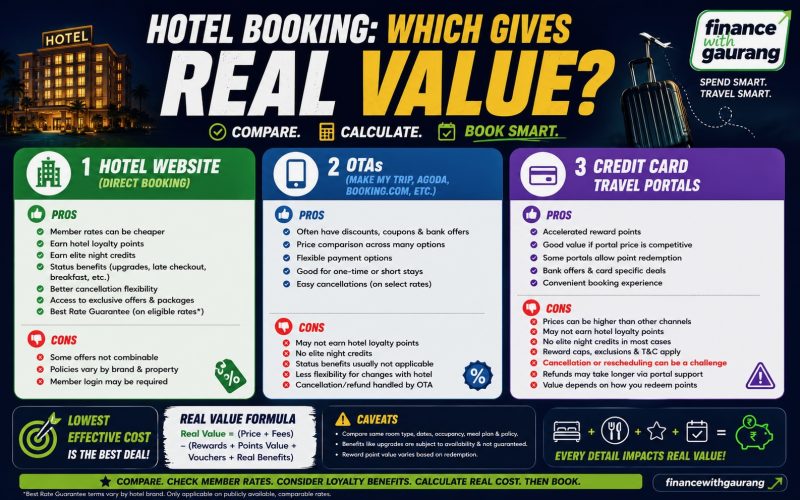
Most people start their hotel booking journey on OTAs.
They open MakeMyTrip, Agoda, Booking.com, Goibibo or a credit card travel portal, compare the visible price, apply a coupon or reward multiplier and assume they have found the best deal.
But that is not always true.
In many cases, the hotel’s own website or app can show a better price once you log in as a member. And even when the price is similar, direct hotel booking can give you benefits that OTAs or third-party portals may not provide.
This is where the real hotel booking ROI starts.
It is not just about the cheapest visible price.
It is not just about credit card reward points.
It is not just about voucher value.
The smarter question is:
What is my final effective cost after considering price, member rates, hotel loyalty points, night credits, status benefits, breakfast, upgrades, cancellation policy and credit card rewards?
That is the calculation most people miss.
The Biggest Mistake People Make While Booking Hotels
The biggest mistake is assuming that OTAs always have the best rates.
Sometimes they do.
But many times, hotel websites offer exclusive member rates that are visible only after you log in. These rates can be lower than the standard public rate. Some hotel chains also run app-only offers, limited-time member offers, stay packages or direct booking promotions.
So if you are checking only OTA prices, you may be missing a cheaper rate on the hotel’s own website.
The second mistake is calculating ROI only on credit card points.
For example, if a credit card travel portal gives you 10% value back in reward points, it may look like a great deal. But if the same hotel is 12% cheaper on the official website, then the portal is not really giving you a superior deal. You are simply paying more upfront and getting some of it back in points.
This is why hotel booking ROI has to be calculated on the final net value, not on reward points alone.
Why Hotel Websites Can Be Better
Booking directly with the hotel can offer multiple advantages.
The first advantage is member pricing.
Many hotel chains have free loyalty programmes. Once you create an account and log in, you may see member-only rates that are cheaper than the regular rates. This is especially common with large hotel chains such as Marriott, Accor, Hyatt, Hilton, IHG and others.
The second advantage is loyalty points.
When you book directly with the hotel through eligible channels, you may earn hotel loyalty points. These points can later be used for free nights, discounts or other redemptions depending on the programme.
The third advantage is elite night credits.
If you are trying to reach or retain a hotel status tier, direct eligible bookings can help you earn night credits. These night credits may move you closer to silver, gold, platinum or higher elite tiers depending on the hotel loyalty programme.
The fourth advantage is status recognition.
If you already hold hotel status, direct bookings are more likely to unlock benefits such as room upgrades, late checkout, welcome amenities, bonus points, breakfast or lounge access, depending on the hotel brand, property and your tier.
The fifth advantage is better control over the booking.
When you book directly, dealing with changes, cancellations, special requests or room preferences can sometimes be easier because the hotel has full visibility of your booking. With OTA bookings, the hotel may redirect you to the OTA for changes or refunds.
OTA Bookings Are Not Always Bad
This does not mean OTAs are bad.
Sometimes OTAs genuinely offer a better deal. They may have bank discounts, wallet offers, coupon codes, app-only pricing or sale prices that make the final amount lower than the hotel website.
If the OTA price is meaningfully lower and the benefits you lose are not valuable to you, booking through an OTA can make sense.
For example, if you are staying at a hotel chain where you do not care about loyalty points or elite night credits, and the OTA is ₹3,000 cheaper, then the OTA may be the better option.
But if the price difference is small, direct booking can become more attractive because of loyalty points, night credits and status benefits.
This is why there is no universal answer.
Sometimes OTAs win.
Sometimes hotel websites win.
Sometimes credit card portals win.
Sometimes vouchers win.
The only correct approach is to compare all options before booking.
Credit Card Portals: Good Only If the Price Is Competitive
Credit card travel portals can be powerful, especially when they offer accelerated reward points on hotel bookings.
But there is one big caveat.
The reward rate should not be viewed in isolation.
If a portal gives you 10% reward value but the hotel is priced 8% higher than the hotel website, your real gain is only around 2% before considering loyalty benefits. If direct booking also gives you hotel points, night credits or status benefits, the credit card portal may actually be less attractive.
This is why you should always compare the portal price with the hotel’s official website and OTA prices.
Do not ask only:
“How many points am I getting?”
Ask:
“Is the platform price competitive?”
“Will I lose hotel loyalty points?”
“Will I lose elite night credits?”
“Will my hotel status be recognised?”
“Is breakfast included?”
“Is the cancellation policy the same?”
“What is my final effective cost?”
That is how you avoid fake ROI.
The Real Cost of Losing Night Credits and Loyalty Benefits
Many people underestimate the value of hotel loyalty benefits.
Night credits can matter a lot if you are chasing status. For frequent travellers, maintaining hotel status can unlock meaningful benefits such as upgrades, breakfast, lounge access, late checkout and bonus points.
Even for occasional travellers, booking directly can sometimes create more value than an OTA discount.
For example, let’s say an OTA is ₹1,000 cheaper.
But direct booking gives you:
Hotel loyalty points
Elite night credit
Possible room upgrade
Late checkout
Breakfast benefit
Better cancellation support
In that case, the direct booking may be the better overall deal, even if the upfront price is slightly higher.
The important point is not to blindly assign inflated value to every benefit. The value should be practical.
If breakfast is included and you were anyway going to pay for breakfast, that is real value.
If an upgrade is only a possibility, it should be treated as a soft benefit.
If night credits help you reach a meaningful tier, they matter more.
If you do not travel often, night credits may matter less.
Your personal travel pattern should decide the value.
Hotel Vouchers: Face Value Is Not Always Real Value
Hotel vouchers are another area where people often overestimate ROI.
A ₹10,000 hotel voucher looks like a ₹10,000 saving. But the real value depends on the rate at which the voucher can be used.
If the voucher can be applied only on a higher standard rate, while the hotel’s member rate or OTA rate is cheaper, then the actual saving may be lower than ₹10,000.
For example:
Hotel member rate: ₹18,000
Voucher-eligible standard rate: ₹22,000
Voucher value: ₹10,000
At first glance, you may think you saved ₹10,000.
But compared to the member rate, you are paying ₹4,000 extra before applying the voucher. So the effective value of the voucher is closer to ₹6,000.
This does not mean vouchers are useless.
It simply means you should not blindly assume that voucher value equals cash value. Always compare the voucher-eligible rate with the lowest comparable rate available.
Best Rate Guarantee Can Be Powerful
Many hotel chains offer some version of Best Rate Guarantee or price match.
This can be useful when you find a cheaper public rate on another platform for the same hotel, same room type, same dates, same occupancy and same cancellation terms.
If the claim is approved, the hotel may match the lower rate or offer an additional benefit, depending on its policy.
This can be one of the smartest ways to book because you may get the lower price while still booking directly with the hotel. That means you may preserve hotel loyalty benefits, night credits and status recognition.
However, Best Rate Guarantee is not always easy.
The competing rate usually has to be publicly available and exactly comparable. Member-only rates, coupon-based rates, opaque rates, package rates or app-exclusive rates may not qualify. Terms differ across hotel chains.
Still, it is worth checking, especially for expensive stays.
Different Ways to Save While Booking Directly With Hotels
Direct booking does not mean paying the highest rate.
There are many ways to reduce cost while booking through the hotel website or app.
You can check member rates after logging in.
You can compare flexible and non-refundable rates.
You can check if breakfast-inclusive packages are better than paying separately.
You can check stay packages that include meals, spa credits, airport transfers or hotel credits.
You can look for seasonal hotel offers.
You can use bank offers available directly on hotel websites.
You can use hotel loyalty points for redemption.
You can use vouchers where they genuinely reduce your final cost.
You can check Best Rate Guarantee.
You can compare rates on the hotel app because some brands offer app-only pricing or additional benefits.
You can contact the hotel directly for longer stays, special occasions or package deals.
The point is simple: direct booking does not always mean expensive booking.
Sometimes, direct booking is the most rewarding way to book.
How to Compare Hotel Booking Options Properly
Before booking any hotel, create a simple comparison.
Compare the same room type, same date, same occupancy, same meal plan and same cancellation policy across platforms.
You should check:
Hotel official website public rate
Hotel member rate after login
Hotel app rate
OTA rate
Credit card travel portal rate
Bank offer price
Voucher eligible rate
Breakfast inclusion
Cancellation policy
Hotel loyalty points
Elite night credits
Status benefits
Credit card rewards
Taxes and fees
Once you compare everything, calculate the final effective cost.
The final effective cost is not just the amount paid.
It is:
Total price paid minus card rewards minus hotel points value minus voucher value minus real benefits you would have otherwise paid for.
But be conservative.
Do not overvalue uncertain benefits like possible upgrades. Count them as additional upside, not guaranteed savings.
A Simple Example
Suppose you are booking a hotel for one night.
OTA price: ₹20,000
Hotel website member rate: ₹19,500
Credit card portal price: ₹21,000
Credit card rewards on portal: ₹2,000 value
At first glance, the credit card portal looks attractive because of ₹2,000 reward value.
But the portal price is ₹1,500 higher than the hotel member rate.
So your real extra gain is only ₹500.
Now add direct booking benefits.
If the hotel website booking also gives you loyalty points, night credit and status recognition, direct booking may become the better option despite lower visible reward points.
This is exactly why the highest reward rate does not always mean the best deal.
When Should You Book Through OTAs?
Book through OTAs when the final price difference is significant and you do not care much about hotel loyalty benefits for that stay.
OTAs can be useful for independent hotels, budget stays, one-time stays, flash deals, bank offers and situations where the price gap is too large to ignore.
But for chain hotels where loyalty benefits matter, always compare direct booking first.
Especially if you are booking Marriott, Taj, Accor, Hyatt, Hilton, IHG or similar chains, check the hotel website and member rate before finalising an OTA booking.
When Should You Book Directly With the Hotel?
Direct booking makes more sense when:
The member rate is cheaper or similar to OTA pricing
You want hotel loyalty points
You want elite night credits
You have hotel status
You want breakfast, upgrades or late checkout benefits
You want better control over cancellations or modifications
You are using hotel vouchers or hotel points
You are chasing a status tier
You are booking a premium or luxury stay
In such cases, the direct booking value can be much higher than the visible price difference.
When Should You Use Credit Card Travel Portals?
Credit card travel portals make sense when:
The portal price is equal to or lower than hotel website pricing
The reward multiplier is genuinely high
You are not losing valuable hotel loyalty benefits
You are booking an independent hotel where loyalty does not matter
The portal has a strong bank offer
The points earned are useful for your travel goals
There is no major cap or exclusion affecting your rewards
But if the portal price is inflated, the reward points may only be giving back what you already overpaid.
Final Hotel Booking Checklist
Before booking your next hotel, check this:
Have I checked the hotel website?
Have I logged in and checked member rates?
Have I checked the hotel app?
Have I compared OTA prices?
Have I checked bank offers?
Have I checked credit card travel portals?
Have I checked if loyalty points will be earned?
Will I get elite night credits?
Will my hotel status be recognised?
Is breakfast included?
Is the cancellation policy comparable?
Can I use Best Rate Guarantee?
Is the voucher actually reducing my cost?
What is the final effective cost?
This checklist can save you a lot of money over time.
Final Thoughts
The best hotel booking deal is not always on an OTA.
It is also not always on the hotel website.
And it is definitely not always the platform giving the highest reward points.
The best deal is the one that gives you the lowest effective cost after considering price, member rates, hotel loyalty points, night credits, status privileges, breakfast, vouchers, cancellation terms and credit card rewards.
Many times, hotel websites can be cheaper after member login. Many times, direct booking can give you benefits that OTAs cannot. And many times, reward points can make a costly booking look attractive when it is actually not.
So the next time you book a hotel, do not blindly chase discounts or points.
Compare first.
Calculate second.
Book third.
That is how you maximise real travel ROI.
